




about us
Stanadyne es un líder mundial en tecnología de automoción en sistemas de gestión de combustible y aire basados en el motor. Nos especializamos en tecnologías pioneras en sistemas de inyección de gasolina y diésel para los motores que hacen que nuestro mundo se mueva, y en componentes de postventa y remanufacturados que ayudan a mantener esos motores en la carretera. Nuestros productos, los mejores de su clase, ofrecen una calidad superior y una ventaja competitiva, proporcionando potencia, rendimiento y eficiencia, y permitiendo a nuestros clientes adelantarse a la rápida evolución de las emisiones y la demanda de los consumidores.
Founded in 1876, our experience is rooted in the foundation of the automotive industry, and we’ve been a trusted partner serving some of the most well-known brands in the world. In 2019, we acquired PurePower Technologies, a leader in engineering and remanufacturing diesel injectors, turbochargers, valves, and other components for OEM and the aftermarket.
Our focus today is in designing, engineering, and enabling solutions for our customers with our diverse global team. Headquartered in Jacksonville, NC, USA, we have design, engineering and manufacturing facilities in the United States, China, India, and a worldwide network of aftermarket service dealers and distributors.
company history
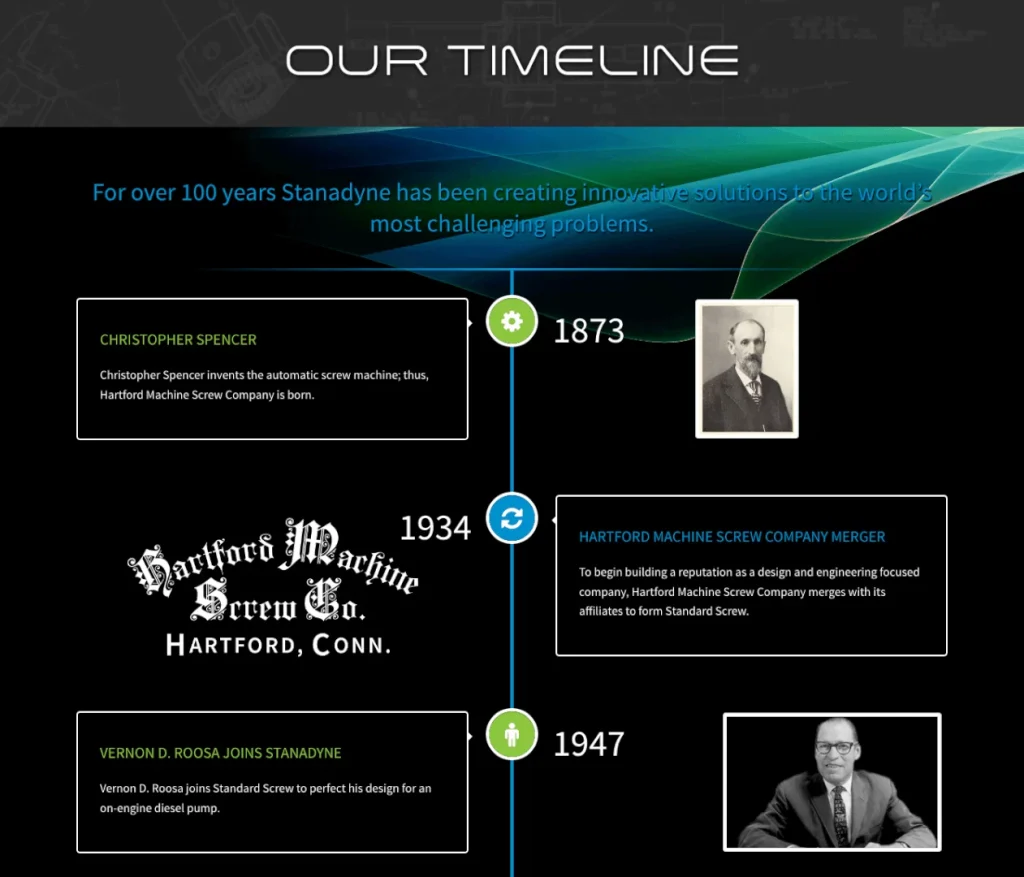
For more than 150 years Stanadyne, and its predecessor companies, has thrived on creating one-of-a-kind solutions to the world’s most vexing problems in diesel and gasoline fuel systems. The company dates back to 1876 as the Hartford Machine Screw Company and was founded on its revolutionary innovation, the automatic screw machine. In ensuing years, Hartford Machine Screw Company markedly improved the efficiency of manufacturing, helping to fuel the industrialization of America.
In 1900, the company changed its name to the Standard Screw Company, eventually becoming a leading supplier of precision metal components. From 1914 to 1945, Standard Screw handled contracts from the United States government to help produce aircraft parts and war materials.
In the post-World War II era, the company entered a new age of innovation. Vernon D. Roosa joined with his design concept for a diesel fuel injection pump that was smaller, lighter, and more technically advanced than the fuel pumps available at the time. The rotary pump, as it became known, greatly improved the efficiency, power, and practicality of diesel engines with new fuel distribution technology, allowing diesel engines to become the primary choice for heavy equipment and machinery.
A medida que el diseño de la bomba rotativa evolucionaba, también lo hacían sus aplicaciones, irrumpiendo en el mercado de la automoción y el transporte, permitiendo a los fabricantes de vehículos desarrollar nuevos motores más eficientes. El uso de motores diésel siguió aumentando y Standard Screw Company se adaptó a los desafíos con nuevas bombas y sistemas de combustible, introduciendo cada vez cambios innovadores que aumentaban la eficiencia y el rendimiento. Otros inventos notables de este periodo son: la bomba rotativa Modelo DB (1952) y el inyector de combustible Pencil Nozzle® (1963).
Cuando Standard Screw Company se convirtió en Stanadyne en 1970, la empresa introdujo una nueva ola de tecnologías, incluyendo filtros de combustible y aditivos. En ese momento, las bombas de combustible diésel Stanadyne ofrecían el diseño más eficiente en cuanto a combustible y la empresa experimentó un rápido crecimiento durante la crisis del petróleo de 1973.
En los años siguientes, la empresa amplió su cartera para incluir el gobierno electrónico bombas rotativas diesel, bombas diesel common rail y bombas de combustible de inyección directa para motores de gasolina. A principios de la década de 2000, Stanadyne introdujo en el mercado de la automoción la primera bomba de inyección directa de gasolina de 200 bares. Rápidamente le siguió otra bomba de inyección directa de gasolina para la industria de las carreras. Con la rápida innovación en los sistemas de combustible de gasolina y diésel, la empresa se encontraba en una encrucijada. En 2014, la empresa vendió el negocio de filtros de combustible y aditivos para centrarse únicamente en las bombas de combustible y los inyectores.
Today, the company is re-imagining its product portfolio and providing tailored solutions for its customers. As the company embraces the future of fuel, it continues to innovate and develop new technology to improve the efficiency, power and performance of fuel systems.